Key takeaways
- Height: Bottle-fed models with top-loading bottles need clearance under wall cabinets. Measure before buying.
- Depth and width: Check that the unit leaves room for cups and cleaning.
- Weight: A full five-gallon bottle is heavy. Confirm your counter and your back can handle it.
- Outlet and plumbing: You need a nearby electrical outlet, and a bottleless unit also needs a water connection and a drain-safe location.
For most households a countertop bottleless dispenser with a built-in filter suits best, because it needs no heavy bottle lifting and can supply both cold and room-temperature water. Choose a bottle-fed countertop model if you have no plumbing nearby, and choose a hot-and-cold model only if a child-safe hot tap matters more than counter space.
Our top picks



As an Amazon Associate we earn from qualifying purchases at no extra cost to you.
Countertop Water Coolers at a Glance
| Type or brand | Best for | Stated features | Limits |
|---|---|---|---|
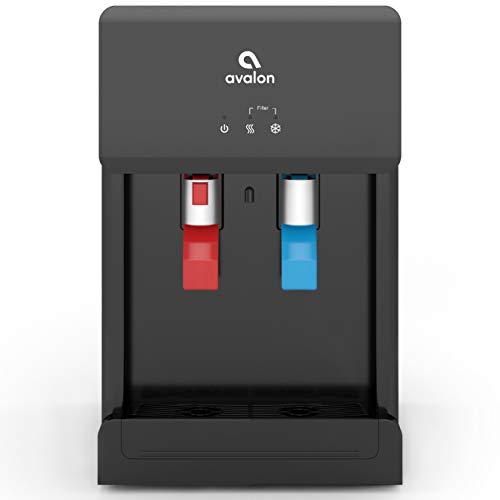
| Avalon countertop bottleless | Kitchens with a nearby water line | The maker lists filtered, cold and hot or room-temperature taps depending on model | Needs a plumbing connection or a plumbing kit |
| Brio countertop models | Offices and homes wanting hot and cold options | Maker lists models with child safety lock on hot water | Features differ by model line |
| Primo countertop dispensers | Households using five-gallon bottles | Bottle-fed design with hot and cold taps listed by the maker | Bottle lifting is required |
| Frigidaire countertop dispensers | Small spaces, bottle-fed | Compact units with hot and cold options on some models | Smaller reservoir on compact designs |
| Whynter countertop dispensers | Compact kitchens and dorms | Maker lists cold and hot taps on select models | Check bottle size compatibility |
Model names and features change between releases, so confirm the specific dispenser on the maker’s page before purchasing.
Bottle-Fed or Bottleless
Bottle-fed
These use a large water bottle, usually five gallons, placed on top or inside the unit. They need no plumbing, which makes them easy to install and move. The downside is lifting heavy bottles, finding storage space and arranging refills.
Bottleless (point-of-use)
These connect to your cold water line and filter the water as it comes in. They take away bottle logistics and run indefinitely, but need a nearby water line, installation time and periodic filter replacement. If you rent, check whether the installation is allowed.
Hot, Cold or Room-Temperature
Cold-only units suit most households. Hot-and-cold units add convenience for tea, instant meals and baby formula preparation, though hot taps raise safety concerns. Look for a child safety lock or similar locking mechanism that the maker describes, and keep the dispenser out of children’s reach regardless.
Some compact models use thermoelectric cooling, which is quiet but cools less aggressively than compressor-based units. Compressor models cool faster and handle heavy use, at the price of a larger size and some noise.
Filtration and Water Quality
A built-in filter can reduce certain contaminants, but claims differ widely. Check what the maker states the filter is certified for, and which standards it references. If you are concerned about specific contaminants, consult your local water report and consider independent testing. Replace filters on the maker’s schedule, because a clogged or expired filter can reduce flow and water quality.
Size, Fit and Counter Space
- Height: Bottle-fed models with top-loading bottles need clearance under wall cabinets. Measure before buying.
- Depth and width: Check that the unit leaves room for cups and cleaning.
- Weight: A full five-gallon bottle is heavy. Confirm your counter and your back can handle it.
- Outlet and plumbing: You need a nearby electrical outlet, and a bottleless unit also needs a water connection and a drain-safe location.
Budget Tiers
- Budget: Compact bottle-fed or thermoelectric dispensers. Fine for light use, with smaller reservoirs and slower cooling.
- Mid-range: Compressor-cooled bottle-fed models and entry-level bottleless units with filters.
- Premium: Bottleless filtered models with hot and cold, sleek stainless finishes and multi-stage filtration.
Pick X If …
| Pick this | If you … |
|---|---|
| Avalon or Brio bottleless | have a water line nearby and want to skip bottles |
| Primo bottle-fed | have no plumbing access and use refill bottles |
| Frigidaire or Whynter compact | have limited counter space and moderate use |
| Hot-and-cold model | want instant hot water and can manage a child lock |
| Cold-only model | want simplicity, lower cost and less safety concern |
Cleaning and Maintenance
Dispensers need regular cleaning because standing water can support bacterial growth. Follow the maker’s cleaning schedule, which often involves sanitizing the reservoir and tap with a solution the manual approves. Wipe the drip tray often, replace filters on time, and unplug the unit before cleaning. If your water is hard, scale can build up in hot tanks, so descaling instructions in the manual are worth following.
Safety Notes
Hot water taps can scald, so use a child lock and keep the dispenser out of reach. Do not place the unit where it can be splashed or near heat sources, and plug it into a properly rated outlet. For bottleless units, hire a qualified plumber if you are unsure about the connection. Follow your local code and the maker’s manual for any electrical or plumbing work.
Alternatives
- Filter pitchers: Inexpensive and portable, but small capacity and filters need frequent changes.
- Under-sink filtration with a dedicated tap: Hidden from view, high capacity, and no counter space needed.
- Refrigerator water dispenser: Convenient if you already have one, but filtration depends on the model.
- Countertop gravity filters: No electricity, but slower and without chilling.
Choosing for Your Household
Household size and usage patterns shape the best choice. A couple who drinks mostly cold water can do well with a compact cold-only unit. A family that fills bottles, cooks with filtered water and makes hot drinks will benefit from a higher-capacity bottleless unit with hot and cold. Offices and shared spaces typically need larger reservoirs and faster recovery, which are features that makers list as cooling capacity or hot water output per hour.
Reading the spec sheet
Look for cooling and heating capacity, reservoir volume, power rating, dimensions and weight. Capacity figures indicate how many cups the unit can cool or heat before slowing, and recovery time shows how quickly it can resume. If the maker lists a noise level, compare it between models, since this is useful in quiet kitchens and apartments.
Taste and water quality
Water taste depends on the source and filter. Activated carbon filters are commonly used to reduce chlorine taste and odor, while other filter types target different contaminants. If water quality is a concern, check your local utility’s report and look for filters that carry third-party certification for the claims you care about. If you have a health condition that makes water quality particularly important, ask your doctor before relying on any home filter.
Placement
Place the unit on a level, stable counter near an outlet, away from stoves and direct sunlight. Leave space around vents for airflow, and keep it away from the edge so it cannot be knocked over. Use a drip tray and wipe up spills quickly, since pooled water near electrical parts is a hazard.
Running Costs and Ownership
Beyond the purchase, consider ongoing costs in general terms. Bottle-fed units need regular bottle refills or exchanges, while bottleless units need replacement filters on a schedule. Hot and cold tanks draw standby power, so models with an energy-saving mode or a switch to turn off heating can help. Over several years, filter and bottle costs often outweigh the unit itself, so compare the maker’s stated filter life and the availability of replacements before you commit.
Also consider noise and heat. A compressor unit can add a little warmth to a small kitchen, and a thermoelectric unit can struggle in a hot room. Leaving breathing room around the vents helps either design perform as the maker intends.
Frequently Asked Questions
Do countertop water coolers need to be plumbed in?
Not always. Bottle-fed models need no plumbing, while bottleless models connect to your cold water line. If you choose bottleless, check the manual for installation steps or hire a plumber.
Are countertop dispensers noisy?
Thermoelectric models are generally quiet, while compressor models make a low hum when cooling. Reviewers mention that noise is most noticeable in small quiet rooms. Check the maker’s stated sound level if it is important to you.
How often should I change the filter?
Follow the maker’s schedule, which depends on the filter type and your usage. Many filters are rated for a set number of gallons or months, whichever comes first. A change in taste, flow or odor is a hint to replace sooner.
Is hot water from a dispenser safe for baby formula?
Consult your pediatrician and the formula maker’s instructions about water temperature and preparation. Dispensers vary in how hot their water gets, and hot taps can scald. Do not assume a given temperature without checking the manual.
How much electricity do they use?
Usage varies by model, with compressor and hot-water tanks drawing more than cold-only thermoelectric units. The maker usually lists wattage on the product page. Some models include energy-saving modes.
Can I use a countertop cooler with tap water directly?
Only bottleless point-of-use models are designed to connect to the water line. Bottle-fed models need bottled water, which you can fill from a safe source. Do not pour tap water into a reservoir unless the manual allows it.