Key takeaways
- Port mix and real wattage: Two USB-A ports were fine in 2019; in 2026 you want at least one USB-C port capable of meaningful power delivery, plus two AC outlets for a lamp and a laptop brick. Check the total amperage rating, not just the port count — some units share a modest supply across every socket.
- Where the power lives: Rear-panel charging keeps cords hidden behind the unit and works well against a wall. In-drawer or under-lid charging goes further: your phone charges fully concealed, which removes the screen from your visual field entirely. That single design choice does more for sleep hygiene than any app feature.
- Light temperature and dimmability: Integrated LEDs are common now, but quality varies enormously. Look for adjustable warm tones in the 2000–2700K range and genuine low-end dimming. Fixed-brightness strips or cool-white-only lighting will suppress melatonin rather than support the wind-down you’re aiming for.
- Height relative to your mattress: Measure from the floor to the top of your mattress and aim for a nightstand within an inch or two. Too low and you’ll reach down awkwardly for water at 3 a.m.; too high and the surface sits in your sightline while you’re lying down.
- Storage that closes: Open shelves collect visual noise. Prioritize at least one enclosed drawer for medication, earplugs, sleep masks, and the reading glasses you keep losing — anything you want accessible but invisible.
What's inside
Anyone who has fumbled in the dark for a charging cable knows the real problem isn’t the phone battery — it’s the pile-up. A single bedside surface ends up hosting a lamp, a book, a glass of water, a smartwatch dock, and a tangle of cords snaking down to a wall outlet halfway across the room. From a sleep-wellness perspective, that clutter matters more than it looks. Cognitive load at bedtime is real: a chaotic nightstand keeps the brain in low-level problem-solving mode at exactly the hour you want it winding down. Add a phone charging inches from your pillow, screen flaring every time a notification lands, and you’ve built a small machine for fragmented sleep.
A nightstand with an integrated charging station solves the physical half of that equation, and — if you choose carefully — helps with the behavioral half too. The best models tuck power inside a drawer or behind a rear panel so devices charge out of sight, add warm dimmable lighting instead of blue-white glare, and give you enclosed storage so the surface stays clear. Below, I’ve reviewed six of the strongest options available in 2026, with notes on which sleep habits each one actually supports. The comparison cards come first; the buying criteria and full reviews follow.
As an Amazon Associate we earn from qualifying purchases.


How to Choose a Nightstand Charging Station (2026)
- Port mix and real wattage: Two USB-A ports were fine in 2019; in 2026 you want at least one USB-C port capable of meaningful power delivery, plus two AC outlets for a lamp and a laptop brick. Check the total amperage rating, not just the port count — some units share a modest supply across every socket.
- Where the power lives: Rear-panel charging keeps cords hidden behind the unit and works well against a wall. In-drawer or under-lid charging goes further: your phone charges fully concealed, which removes the screen from your visual field entirely. That single design choice does more for sleep hygiene than any app feature.
- Light temperature and dimmability: Integrated LEDs are common now, but quality varies enormously. Look for adjustable warm tones in the 2000–2700K range and genuine low-end dimming. Fixed-brightness strips or cool-white-only lighting will suppress melatonin rather than support the wind-down you’re aiming for.
- Height relative to your mattress: Measure from the floor to the top of your mattress and aim for a nightstand within an inch or two. Too low and you’ll reach down awkwardly for water at 3 a.m.; too high and the surface sits in your sightline while you’re lying down.
- Storage that closes: Open shelves collect visual noise. Prioritize at least one enclosed drawer for medication, earplugs, sleep masks, and the reading glasses you keep losing — anything you want accessible but invisible.
The Best Nightstand Charging Stations (2026), Reviewed
Lazzanto Nightstand with Rear Charging Station
The industrial-style frame and raised back guard make this the most practical pick for anyone who reads in bed and shoves things toward the wall — nothing slides off the back. Three fabric drawers give you genuinely closed storage, and the rear-mounted USB-A ports and outlets keep cabling contained, though USB-C users will want to bring an adapter.
WLIVE LED Nightstand with Sliding Top
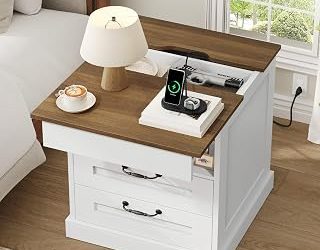
The sliding top is the standout feature here: your phone charges in a hidden compartment beneath the surface, which is the single most effective way I’ve seen furniture design discourage midnight scrolling. App-controlled LED strips let you preset a warm, dim evening scene once and stop thinking about it.
SONGMICS BELLAH Nightstand
The most design-forward option on this list, with a layered ink-and-ebony finish that reads as intentional rather than utilitarian. Two drawers plus an open shelf strike a sensible balance, and the app-adjustable lighting offers finer control over color temperature than most competitors in this price band.
SUPERJARE 3-Tier Nightstand with Charging Station
Best suited to smaller bedrooms where vertical storage beats footprint — the three tiers hold a surprising amount, and the adjustable fabric drawer flexes for bulkier items like a tablet or a book stack. The rustic brown and black palette pairs easily with existing furniture you don’t want to replace.
Yoobure Nightstand with Charging Station
A compact, unfussy choice for dorms, guest rooms, and tight corners, with fabric drawers that keep clutter concealed and both USB ports and outlets on board. It skips integrated lighting entirely, which is arguably a feature if you’d rather pair it with a warm bulb in a lamp you already trust.
Frequently Asked Questions
Is charging my phone next to my bed unsafe?
Reputable units use certified components and don’t pose a meaningful fire risk under normal use. The real concern is behavioral, not electrical: a phone within arm’s reach invites checking. In-drawer charging designs sidestep the problem neatly.
Do the LED lights hurt sleep quality?
They can, if they’re bright or cool-toned. Set integrated lighting to its warmest setting and lowest usable brightness, and treat it as ambient orientation light rather than task light. Anything you can comfortably read fine print by is too bright for the hour before sleep.
Will these work with my wireless charger?
Yes — plug a wireless pad into one of the built-in AC outlets or USB ports. Just confirm the unit supplies enough wattage for fast wireless charging, since some shared power supplies deliver less than a standalone wall adapter.
How difficult is assembly?
Expect 30 to 60 minutes for most models. The electrical module typically arrives pre-wired as a single sealed component that you screw into place, so no wiring knowledge is required.
Final Thoughts
If you want the version that actively supports better sleep rather than just tidier cables, the WLIVE sliding-top model is the clear choice — concealed charging changes bedtime behavior in a way no other feature does. The SONGMICS BELLAH is the pick for style-conscious bedrooms with the best lighting control on this list, while the Lazzanto offers the most storage and the most reassuring build for the money.