Key takeaways
- CFM before horsepower: Blasting is a continuous-draw application. Match delivered CFM at 90–125 PSI to your nozzle: a 3/32″ tip wants roughly 8–12 CFM, a 1/4″ tip can demand 60 CFM or more. Horsepower ratings on their own tell you almost nothing.
- Duty cycle and cooling: Reciprocating compressors typically run 50–75% duty. Rotary screw units run continuously without heat soak, which is why production shops standardise on them despite the price gap.
- Moisture control is non-negotiable: Wet abrasive clumps and clogs. Budget for a refrigerated dryer, or at minimum a water separator and a generously sized tank that lets condensate drop out before the line.
- Noise and placement: Check the dB rating and where the unit will physically live. Rotary screws are noticeably quieter than piston pumps at comparable output, and an insulated enclosure or a detached wall does more for household sleep than any earplug.
- Electrical reality check: Anything above 5 HP realistically needs 230V, and industrial units require 480V three-phase service. Confirm your panel capacity before you buy, not after delivery.
What's inside
Sandblasting is one of the few workshop tasks that punishes an undersized compressor immediately. The moment your nozzle draws more air than the pump can replace, pressure sags, the abrasive stream stutters, and what should have been a clean etched surface turns into a blotchy, half-stripped mess. Most buyers discover this the hard way: they bolt a blast gun onto a pancake compressor rated for brad nailers and wonder why a single door hinge takes forty minutes.
There’s a second cost nobody mentions in the spec sheet, and as someone who spends most of my working life on sleep hygiene and acoustic environments, it’s the one I’d flag first. A compressor cycling at 85–95 decibels in an attached garage travels straight through shared walls into bedrooms, and intermittent noise disrupts sleep architecture far more than steady sound does. This guide covers how to size a compressor properly for continuous blasting duty, which units earn their footprint, and how to keep your workshop from wrecking the household’s rest.
As an Amazon Associate we earn from qualifying purchases.




How to Choose an Air Compressor For Sand Blasting (2026)
- CFM before horsepower: Blasting is a continuous-draw application. Match delivered CFM at 90–125 PSI to your nozzle: a 3/32″ tip wants roughly 8–12 CFM, a 1/4″ tip can demand 60 CFM or more. Horsepower ratings on their own tell you almost nothing.
- Duty cycle and cooling: Reciprocating compressors typically run 50–75% duty. Rotary screw units run continuously without heat soak, which is why production shops standardise on them despite the price gap.
- Moisture control is non-negotiable: Wet abrasive clumps and clogs. Budget for a refrigerated dryer, or at minimum a water separator and a generously sized tank that lets condensate drop out before the line.
- Noise and placement: Check the dB rating and where the unit will physically live. Rotary screws are noticeably quieter than piston pumps at comparable output, and an insulated enclosure or a detached wall does more for household sleep than any earplug.
- Electrical reality check: Anything above 5 HP realistically needs 230V, and industrial units require 480V three-phase service. Confirm your panel capacity before you buy, not after delivery.
The Best Air Compressors For Sand Blasting (2026) Reviewed
40HP VSD Rotary Screw Air Compressor, 185 CFM @ 125 PSI
This is the correct answer for anyone running large nozzles or a blast pot all day: 185 CFM sustained means you can strip a chassis without waiting on recovery. The variable speed drive is the real selling point, trimming both power draw and acoustic output during partial load rather than slamming on and off.
7.5KW 10HP Rotary Screw with 80 Gal Tank and Dryer
An all-in-one package that solves the two problems most serious hobbyists hit at once — insufficient sustained airflow and moisture in the abrasive line. At 35 CFM it comfortably feeds cabinet work and mid-size nozzles, and the integrated dryer eliminates a separate purchase.
Light-Duty Air Sandblaster Gun Kit with Siphon and Gravity Feed
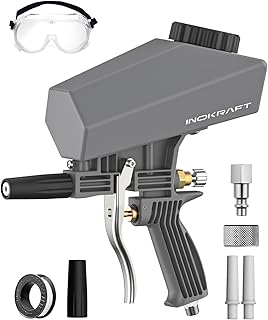
A sensible entry point for etching glass, cleaning small brackets, or prepping furniture hardware, with dual feed options and a replaceable ceramic nozzle. Understand that it’s a tool, not a compressor — pair it with something delivering at least 6–8 CFM or you’ll be blasting in short bursts.
Inokraft Portable Sand Blaster Gun Basic Kit
Designed around the 60–120 PSI range most home compressors actually achieve, and the leak-proof design spares you the abrasive dust cloud cheaper guns produce. Compatible with aluminium oxide and soda, which makes it flexible for delicate refinishing work on furniture legs and vintage hardware.
40 Gallon Bench Top Air Sandblasting Cabinet
The single best upgrade for anyone blasting indoors, because containment means less airborne silica, less cleanup, and recoverable media. Its 6–25 CFM requirement is modest enough for a well-chosen two-stage piston compressor, and the four included nozzles cover most rust and paint removal jobs.
Frequently Asked Questions
Can I sandblast with a small pancake compressor?
Only in very short bursts on tiny parts. Blasting draws air continuously, so a 2–3 CFM unit will spend most of its time recovering rather than working, and the constant cycling shortens pump life considerably.
How loud are these compressors, and does it matter?
Piston units commonly hit 85–90 dB, rotary screws often sit in the 65–75 dB range. Because intermittent noise fragments sleep more than constant noise, an on-off piston compressor in an attached garage is far more disruptive to a sleeping household than its average reading suggests.
Do I need an air dryer?
For anything beyond occasional light work, yes. Humid air turns abrasive into paste, blocks nozzles, and leaves flash rust on freshly stripped steel.
What about airbrush compressors?
Units like the PointZero 1/5 HP with tank and water trap are excellent for fine detail and quiet enough for indoor use, but they lack the volume for genuine sandblasting.
Final Thoughts
For sustained production blasting, the 40HP VSD rotary screw is the only unit here that never becomes the bottleneck. Most serious home and small-shop users are better served by the 7.5KW 10HP rotary screw with integrated dryer, ideally paired with the 40 Gallon Bench Top Sandblasting Cabinet to contain media, cut dust, and keep the whole operation quiet enough that nobody upstairs notices.