Key takeaways
- Label the drawer face, not the trays — you read the label before you open, which is when the information is useful.
- Leave roughly fifteen percent of each drawer empty. Full systems have nowhere to put new acquisitions, so tools end up loose on the bench.
- Adopt a two-minute close-out at the end of every project: tools back in assigned trays before you wash your hands. This is the habit that preserves everything else.
- Keep a small consumables tray for fasteners, zip ties, and blades, and restock it monthly so a job never stalls on a missing five-cent part.
What's inside
Most people who write about tool storage focus on the tools. I come at it from the other end of the day — from the wind-down. In sleep coaching, we talk constantly about “unfinished business”: the low-grade mental buzz that keeps a body horizontal but a brain awake. A garage drawer you lost twenty minutes digging through at 8 p.m. is unfinished business. So is the half-repaired chair leg you abandoned because the right driver bit vanished. Physical clutter has a way of becoming cognitive clutter, and cognitive clutter has a way of showing up at 1 a.m.
This guide treats tool chest organization as a small piece of household sleep hygiene. You’ll learn how to audit what you actually own, how to divide drawers so retrieval takes seconds instead of minutes, which materials survive a decade of use, how to handle sockets and other pieces that refuse to stay put, and how to build a five-minute reset habit that keeps the system from decaying. Recommended gear appears below.
As an Amazon Associate we earn from qualifying purchases.



Start With a Full Dump, Not a Tidy-Up
Empty every drawer onto a bedsheet or a sheet of cardboard. This feels excessive and it is the single highest-value step. Sorting inside a drawer only rearranges the problem; you can’t see duplicates, dead batteries, or the three tape measures you kept buying because you couldn’t find the first one. Group into four piles: daily-use, seasonal or project-specific, broken or obsolete, and doesn’t-belong-here. Only the first two earn drawer space. Everything in pile three leaves the house this week, not “eventually” — deferred decisions are exactly the kind of open loop that taxes attention.
Divide by Frequency, Then by Size
The instinct is to sort by category: all wrenches together, all electrical together. Frequency beats category. Your top drawer should hold the fifteen or so items you reach for in ninety percent of jobs — a driver, a utility knife, pliers, a tape, a level, your most-used bits. Deeper drawers take the specialists. Within each drawer, then sort by size and fit dividers around what’s actually there.
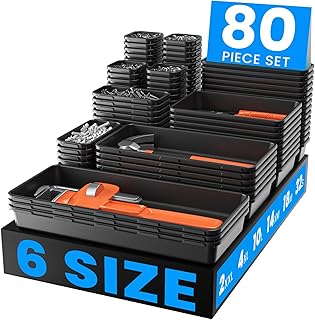
Modular tray sets do this far better than fixed-compartment inserts, because you can rebuild the layout when your kit changes. The A-LuGei 69-piece, 5-size divider set covers most standard chests with room for larger hand tools, while the 80-piece 6-size version suits deeper or wider drawers and handles collections past the hundred-tool mark. For a compact chest, a single bathroom cabinet, or a workbench drawer, the 46-piece 5-size set is the sensible starting point.
Judge Materials by the Rattle Test
Thin plastic bins telegraph every drawer slam and shift under load, which means your carefully planned layout drifts back into chaos within a month. Look for extra-thick walls, a matte or textured base that resists sliding, and dividers that interlock or friction-fit rather than float free. The A-LuGei 6-size extra-thick tray set is built for this kind of abuse and works equally well in an office desk if you’re organizing a home workspace rather than a garage. A quiet drawer is also a genuinely nicer thing to open at the end of a long day — small ergonomic wins compound.
Give Sockets and Small Parts Their Own Logic
Sockets are the classic failure point: they roll, they nest, they hide. Loose sockets in a tray will defeat any system. A dedicated magnetic holder solves it structurally. The EACELIY magnetic socket organizer set covers 1/4″, 3/8″, and 1/2″ drives in both SAE and metric, shallow and deep, and mounts directly to a steel chest or cart — so sizes stay in sequence and a missing socket is visible at a glance rather than discovered mid-job.
Decide Whether Your Chest Should Travel
If a meaningful share of your work happens away from the bench — a rental property, a yard, a second floor — a static chest guarantees repeated trips and repeated frustration. A modular rolling system like the Keter Stack N Roll three-piece setup lets you detach a single box and take only what the job needs, with all-terrain wheels and a telescoping handle for uneven ground. Weatherproof construction matters if any part of the stack lives in an unheated space.
Tips
- Label the drawer face, not the trays — you read the label before you open, which is when the information is useful.
- Leave roughly fifteen percent of each drawer empty. Full systems have nowhere to put new acquisitions, so tools end up loose on the bench.
- Adopt a two-minute close-out at the end of every project: tools back in assigned trays before you wash your hands. This is the habit that preserves everything else.
- Keep a small consumables tray for fasteners, zip ties, and blades, and restock it monthly so a job never stalls on a missing five-cent part.
Frequently Asked Questions
How many divider sizes do I actually need?
Most home users are well served by four to six sizes. Fewer than four and you’ll be wedging small items into oversized bins; more than six and you spend longer deciding where something goes than putting it away.
Should I use foam cutouts instead of trays?
Foam shadowing is excellent for a fixed, unchanging kit and makes missing tools instantly obvious. It’s a poor fit for a growing collection, since every new tool means recutting. Trays are the better default for home use.
Can these organizers work outside the garage?
Yes. The same tray systems work in desk drawers, bathroom vanities, craft stations, and kitchen utility drawers. The principles — frequency-first placement, thick walls, non-slip bases — are identical.
How long should this project take?
Budget two to three hours for a full-chest reset, ideally in the morning or early afternoon. Avoid starting it late in the evening; decision-heavy sorting close to bedtime tends to keep the mind churning well past lights-out.
Conclusion
A well-organized tool chest isn’t about aesthetics or showing off a pegboard — it’s about removing dozens of tiny friction points from your week, each of which quietly costs you time, patience, and sometimes rest. Dump everything out, arrange by how often you reach for it, invest in dividers rigid enough to hold their shape, contain your sockets properly, and protect the system with a two-minute habit. Done once and maintained lightly, it’s the kind of small domestic order that makes the end of the day noticeably easier to put down.