Key takeaways
- Match TPI to material thickness: Aim for at least three teeth engaged in the cut at all times. Thin wall tubing and sheet hardware want 14–18 TPI; thicker solid stock and softer metals want a coarser 5–8 TPI so chips can clear instead of packing.
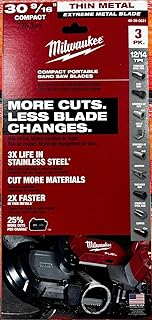
- Confirm the exact blade length: Band saws are unforgiving here. A 93″ frame will not accept a 111.25″ loop, and portable saws are split between roughly 44-7/8″ and 30-9/16″ formats depending on whether the tool is full-size or compact.
- Choose bimetal for mixed-material work: Bimetal construction pairs a flexible backer with hardened high-speed steel teeth, which is why it survives the occasional unexpected hardened screw or weld bead far better than carbon steel.
- Understand set patterns: Wavy set spreads tooth wear across groups and excels on thin or varying-thickness stock. Raker set gives a flatter, faster cut on consistent solid sections. Variable pitch in either pattern breaks up harmonic resonance — the main source of that ear-splitting squeal.
- Buy multi-packs for portable saws: Handheld band saws chew through blades quickly, and swapping a fresh blade in mid-project costs nothing compared to forcing a dull one. Five-packs and three-packs are almost always the better value per cut.
What's inside
Most people don’t shop for band saw blades until something has already gone wrong: a cut that wandered off the line, a bed rail that came out with a rippled face, or a blade that dulled halfway through a stack of steel angle brackets. The frustrating part is that the saw usually isn’t the problem. Blade geometry, tooth count, and set pattern do most of the work, and a mismatched blade will make an excellent machine feel cheap, noisy, and unpredictable. Vibration and screech aren’t just annoying — in a home shop attached to a house where someone is sleeping, they’re the difference between an evening project and a domestic incident.
This guide looks at band saw blades from a practical bedroom-furniture perspective: the metal fasteners, hardware plates, threaded rod, and tubing that go into platform beds and headboard frames, plus the cleaner, quieter cuts that keep late-night shop time tolerable. Below you’ll find picks for both stationary saws and portable models, followed by a buying framework, short expert reviews, and answers to the questions that come up most often.
As an Amazon Associate we earn from qualifying purchases.


How to Choose a Band Saw Blades (2026)
- Match TPI to material thickness: Aim for at least three teeth engaged in the cut at all times. Thin wall tubing and sheet hardware want 14–18 TPI; thicker solid stock and softer metals want a coarser 5–8 TPI so chips can clear instead of packing.
- Confirm the exact blade length: Band saws are unforgiving here. A 93″ frame will not accept a 111.25″ loop, and portable saws are split between roughly 44-7/8″ and 30-9/16″ formats depending on whether the tool is full-size or compact.
- Choose bimetal for mixed-material work: Bimetal construction pairs a flexible backer with hardened high-speed steel teeth, which is why it survives the occasional unexpected hardened screw or weld bead far better than carbon steel.
- Understand set patterns: Wavy set spreads tooth wear across groups and excels on thin or varying-thickness stock. Raker set gives a flatter, faster cut on consistent solid sections. Variable pitch in either pattern breaks up harmonic resonance — the main source of that ear-splitting squeal.
- Buy multi-packs for portable saws: Handheld band saws chew through blades quickly, and swapping a fresh blade in mid-project costs nothing compared to forcing a dull one. Five-packs and three-packs are almost always the better value per cut.
The Best Band Saw Blades (2026)s Reviewed
Lenox Classic Tuff Tooth, 93″ x 3/4″, 18 TPI
The wavy-set, positive-rake tooth form here produces a genuinely smooth finish on thin-wall tube and flat bar, which matters when a cut edge ends up visible on a bed frame joint. At 3/4″ wide with a 0.035″ backer, it also tracks well enough to keep long rip-style cuts from drifting.
FOXBC 44-7/8″ Portable Bandsaw Blades, 14 TPI (5-Pack)
A sensible budget replacement for Milwaukee 48-39-0511 and DeWalt DW3982 blades, and the five-pack pricing means you can retire a blade the moment it starts burnishing instead of cutting. Expect solid life on mild steel hardware and threaded rod, with the understanding that premium bimetal still outlasts it on abrasive stock.
Lenox Classic Pro Vari-Raker, 111.25″ x 1″, 5–8 TPI
This is the blade for thicker solid stock on a larger stationary saw. The variable 5–8 TPI raker set clears chips aggressively and noticeably damps the resonance that makes coarse blades howl, so cuts go faster and quieter at the same time.
Lenox Diemaster 2, 93″ x 3/8″, 14–18 TPI
The narrow 3/8″ width makes this the pick for tight radii and curved brackets, and the variable 14–18 TPI pitch handles changing wall thickness without stripping teeth. It’s the most versatile blade on this list for small, fussy metal parts.
LENOX Portable Band Saw Blades, 44-7/8″ x 1/2″, 14 TPI (5-Pack)
The reference standard for handheld saws: consistent weld quality, predictable break-in, and long life on structural steel and conduit. If your portable saw earns its keep, this is the pack to keep on the shelf.
Frequently Asked Questions
How do I break in a new band saw blade?
Run the first several cuts at roughly half your normal feed pressure. This knocks the microscopic burrs off fresh teeth gradually instead of fracturing them, and it can easily double total blade life.
Why is my blade squealing so loudly?
Usually too fine a tooth pitch for the material, too much feed pressure, or a constant-pitch blade resonating at a fixed frequency. A variable-pitch blade and a lighter, steadier feed solve most noise complaints.
Can I cut wood with these blades?
Not effectively. These are metal-cutting blades with high tooth counts and shallow gullets that pack immediately with sawdust. Use a dedicated wood blade with 3–6 TPI for furniture stock.
How do I know when a blade is worn out?
Watch for cuts that take longer, produce dust rather than curled chips, wander from the line, or leave burn marks. Any of these means the teeth are gone, and pushing harder only risks a broken band.
Final Thoughts
For stationary saws doing precise, quiet work on bed hardware and thin stock, the Lenox Classic Tuff Tooth is the standout, with the Lenox Diemaster 2 as the better choice when you need a narrower blade for curves and mixed thicknesses. If you’re feeding a portable saw, the LENOX 44-7/8″ five-pack is the reliable default, and the FOXBC five-pack is the smart way to keep spares on hand without overspending.