Key takeaways
- Warm-up time over peak temperature: A unit that hits 130°F in eight minutes will get used far more often than one that reaches 160°F in forty. For an evening wind-down, total ritual length matters more than the number on the dial.
- Dry infrared vs. steam-assisted: Dry heat is gentler on bedrooms and easier to tolerate for longer sits. Steamer-equipped tents feel more intense and clear the sinuses, but they add humidity you’ll need to ventilate before sleep.
- EMF and emitter quality: Look for published low-EMF testing and stated emitter wavelength ranges. Far-infrared in the 7–14 micron band is the well-studied territory; vague “infrared” claims with no spec sheet deserve skepticism.
- Footprint and teardown honesty: Be realistic. A cabin needs permanent floor space and a dedicated outlet; a folding tent can live in a closet. The best sauna is the one you don’t have to negotiate with your household about.
- Timers, remotes, and light control: A 99-minute timer with auto shutoff and a remote you can reach from inside prevents the mid-session fumbling that undoes a calm state. If you’re sitting after dark, being able to switch bright therapy LEDs off matters for melatonin.
What's inside
Most people shopping for an infrared sauna aren’t chasing a spa aesthetic — they’re chasing sleep. They lie awake with a racing mind at 11:40 p.m., wake at 3 a.m. warm and wired, or drag themselves through afternoons on six broken hours. Heat exposure is one of the few non-pharmacological levers with a plausible mechanism behind it: warming the body’s shell, then letting it dump that heat, exaggerates the natural core-temperature drop that precedes sleep onset. The problem is that the sauna market has almost nothing to say about this. Listings compete on wattage, LED counts, and “detox” language, leaving buyers to guess whether a $200 tent and a $4,000 cabin do remotely the same job.
This guide approaches the category from a sleep-and-recovery standpoint rather than a home-gym one. I’ve weighed each option on how well it supports a repeatable pre-bed heat ritual: how fast it reaches a useful temperature, whether it can be set up in a bedroom or hallway without a renovation, how quietly and cleanly it runs, and whether the timer and controls let you finish a session without checking a phone. Below you’ll find the current standouts, a short buying framework, and answers to the questions that actually determine whether your sauna gets used three times a week or once a quarter.
As an Amazon Associate we earn from qualifying purchases.


🛒 Best Price Today on Amazon
Prime members get fast, free shipping on everything above, plus member-only deals. New members get a 30-day free trial — cancel anytime.
How to Choose an Infrared Sauna Brand (2026)
- Warm-up time over peak temperature: A unit that hits 130°F in eight minutes will get used far more often than one that reaches 160°F in forty. For an evening wind-down, total ritual length matters more than the number on the dial.
- Dry infrared vs. steam-assisted: Dry heat is gentler on bedrooms and easier to tolerate for longer sits. Steamer-equipped tents feel more intense and clear the sinuses, but they add humidity you’ll need to ventilate before sleep.
- EMF and emitter quality: Look for published low-EMF testing and stated emitter wavelength ranges. Far-infrared in the 7–14 micron band is the well-studied territory; vague “infrared” claims with no spec sheet deserve skepticism.
- Footprint and teardown honesty: Be realistic. A cabin needs permanent floor space and a dedicated outlet; a folding tent can live in a closet. The best sauna is the one you don’t have to negotiate with your household about.
- Timers, remotes, and light control: A 99-minute timer with auto shutoff and a remote you can reach from inside prevents the mid-session fumbling that undoes a calm state. If you’re sitting after dark, being able to switch bright therapy LEDs off matters for melatonin.
The Best Infrared Saunas of 2026, Reviewed
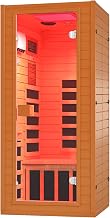
1–2 Person Infrared Sauna with Red Light Therapy and Bluetooth
This is the pick if you want a genuine wooden cabin experience in a 40-inch footprint, and the dry-heat delivery is ideal for late sessions since it won’t leave your room humid. The Bluetooth and radio are more useful than they sound — a fixed 20-minute audio program is an easy way to time a session without a screen — though I’d run the 7-color light on dim or off after sunset.
Relax Sauna Portable Far Infrared Sauna
The most technically transparent unit here, with a patented generator, a stated 7–14 micron semiconductor emitter, and low-EMF construction that puts it ahead of most tents on spec credibility. It’s a bare-bones chair-and-frame design with no steamer or LEDs, which is precisely why serious users like it: fast, dry, quiet heat and nothing to manage.
LifePro Revivify Deluxe Portable Sauna
The most beginner-friendly option, pairing red light therapy with a 2.6L steamer and included essential oils in a setup that takes minutes. The scent element is worth more than it appears — a consistent aroma cue becomes a conditioned signal for wind-down after a couple of weeks of use.
Infrared Sauna Box with 660nm & 850nm Red Light Therapy
Strong specs for the money: dual-wavelength therapy panel, a 3L/1200W steamer, nine heat levels, and a folding chair that makes 25-minute sits genuinely comfortable. The 1200W steamer runs hot and fast, so start at level four or five rather than the top setting.
2-Person Portable Infrared Sauna Box with 160 LEDs
The best choice for couples or anyone who wants a partner to share the habit, with two steamers, 160 dual-wavelength LEDs, and a 99-minute timer with remote. Adherence rises sharply when a routine is social, and this is the rare tent that comfortably accommodates two.
Frequently Asked Questions
How long before bed should I use an infrared sauna?
Aim to finish 90 minutes to two hours before lights out. You want the post-session cooling curve — not the heat itself — to overlap with sleep onset, so leave time to shower in lukewarm water and let your skin temperature settle.
How often should I use it for sleep benefits?
Three to four sessions weekly, 15–25 minutes each, is a reasonable target. Consistency outperforms intensity; a short habitual session beats an occasional endurance test.
Is a portable tent really comparable to a cabin sauna?
For the physiological effect, largely yes — both raise skin and core temperature. Cabins win on comfort, longevity, and posture; tents win on cost, storage, and the odds you’ll actually use them.
Should I use red light therapy at night?
Red and near-infrared wavelengths are less melatonin-suppressing than blue-heavy light, but bright panels are still bright. If you’re sensitive, schedule your red light sessions in the morning and keep evening sauna sits dim.
Final Thoughts
For a permanent, bedroom-friendly dry-heat setup, the 1–2 Person Infrared Sauna cabin is the most sustainable long-term choice. If specification transparency and low EMF are your priorities, the Relax Sauna Portable Far Infrared unit is the most defensible buy in the category, while the LifePro Revivify Deluxe remains the easiest on-ramp for anyone building the habit from scratch.