Key takeaways
- Holds the head level with the spine all night; memory foam does not compress or shift the way fiber or feather fill does.
- Raised side sections give a side sleeper a consistent 4 to 6 inch loft without stacking two pillows.
- Adjustable models with a removable insert let you fine-tune height in half-inch steps.
- The cutout or lower shelf at the front leaves room for the arm and shoulder, which reduces the shoulder-rolling-forward problem common with flat pillows.
- Cooling covers and ventilated foam run cooler than a solid foam block, which matters for side sleepers who press one side of the face into the pillow.
- Lasts 2 to 4 years with nightly use before the foam noticeably softens, longer than most $20 fiber pillows.
- Washable covers keep skin oils off the foam, and the price of $25 to $60 is modest for a pillow you use 8 hours a night.
What's inside
The Short Answer
Yes, a cervical pillow is worth it for a side sleeper, on one condition: the side of the pillow you sleep on has to be tall enough to fill the gap between your ear and the mattress, which for most adults is 4 to 6 inches. Cervical pillows are built with a raised edge and a dip in the middle, and that dip is designed for back sleepers. Side sleepers use the higher edge or the taller end of the wave. If the pillow’s tallest point is under 4 inches, your head will tilt down toward the mattress all night and you will wake up with the exact neck ache you were trying to fix.
Buy one if you wake with neck or shoulder stiffness, you are between about 5 feet 2 inches and 6 feet 2 inches, and you sleep on your side for most of the night. Skip it if you are a stomach sleeper, you toss constantly between positions, or you already own a firm pillow at the right height that works.
As an Amazon Associate we earn from qualifying purchases at no extra cost to you. Product prices and availability are accurate as of the date shown and are subject to change.

What You Actually Get
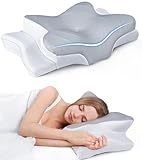
A cervical pillow is a molded block of memory foam, usually 23 to 24 inches wide, 13 to 15 inches deep, and 4 to 5 inches tall at the high edge with a 3 to 4 inch low edge. The dip in the center cradles the back of the head when you lie on your back; the raised ridges support the neck. For a side sleeper, the useful part is the taller ridge and, on many designs, the raised side wings that keep the head level when the shoulder is on the mattress.
Most models in the $25 to $60 range ship with a removable, washable cover and some form of cooling treatment, either a gel layer or a breathable knit. Mid-range examples such as the Ultra Pain Relief Cooling Pillow for Neck Support at $39.98 add a removable inner insert so the total height can be dropped by roughly half an inch to an inch, which is the single most important feature for a side sleeper because it lets you match the pillow to your shoulder width rather than guessing.
Weight is typically 2 to 4 pounds. Foam density in this price range is medium; it feels firm for the first night or two and softens slightly as it warms to body temperature. Expect a mild foam smell out of the box that clears in one to three days of airing.
Pros
- Holds the head level with the spine all night; memory foam does not compress or shift the way fiber or feather fill does.
- Raised side sections give a side sleeper a consistent 4 to 6 inch loft without stacking two pillows.
- Adjustable models with a removable insert let you fine-tune height in half-inch steps.
- The cutout or lower shelf at the front leaves room for the arm and shoulder, which reduces the shoulder-rolling-forward problem common with flat pillows.
- Cooling covers and ventilated foam run cooler than a solid foam block, which matters for side sleepers who press one side of the face into the pillow.
- Lasts 2 to 4 years with nightly use before the foam noticeably softens, longer than most $20 fiber pillows.
- Washable covers keep skin oils off the foam, and the price of $25 to $60 is modest for a pillow you use 8 hours a night.
Cons
- There is a 3 to 14 night adjustment period. The first few nights often feel worse before they feel better, and many people give up too early.
- The shape only works in one or two orientations. If you flip the pillow or drift to the wrong side, the contour is fighting you instead of helping.
- Fixed-height models cannot be adjusted. If the high edge is 5 inches and you need 4, there is nothing to do but return it.
- Memory foam is warmer than buckwheat, latex, or feather even with cooling covers.
- Combination sleepers who spend part of the night on their stomach will find the 4 to 5 inch ridge far too tall for that position.
- The foam block does not fit a standard pillowcase neatly, so you are usually limited to the included cover.
- Off-gassing odor for the first couple of days bothers some people.
Who Should Buy It
Dedicated side sleepers who wake with a stiff neck or a tight upper trapezius are the clearest match. So are people with broad shoulders who have never found a normal pillow tall enough; the raised wing on a cervical pillow usually solves that. Anyone who currently sleeps on two stacked pillows to get height should try one, since two soft pillows drift apart during the night and a single molded pillow does not. Adjustable models are the safest first purchase because they cover a wider height range.
Who Should Skip It
Stomach sleepers should not buy a cervical pillow; they need 2 inches of loft or less. People who rotate through all three positions every night are better served by a lower, softer pillow that does not have a fixed shape. If you are under about 5 feet 2 inches with narrow shoulders, most cervical pillows will be too tall on the side edge unless the model has a removable insert. Finally, if you already sleep well, there is no reason to change a pillow that works.
Cheaper Alternatives
| Option | Cost | Trade-off |
|---|---|---|
| Firm shredded memory foam pillow with zipper | $20 to $35 | Adjustable height by removing fill, but no contour; needs occasional fluffing |
| Rolled towel inside a regular pillowcase | $0 | Adds neck support to a pillow you already own; unravels and needs resetting most nights |
| Buckwheat hull pillow | $35 to $60 | Fully adjustable and cool, but heavy at 7 to 10 lbs and rustles when you move |
| Two firm standard pillows stacked | $0 to $30 | Reaches side-sleeper height but the pillows slide apart during the night |
| Low-cost fixed contour pillow | $20 to $30 | Same shape as the mid-range option but no height adjustment and thinner covers |
| Small cervical roll placed under a flat pillow | $15 to $30 | Supports the neck curve but does not raise the head, so it suits back sleepers more than side sleepers |
FAQ
Which side of a cervical pillow should a side sleeper use?
Use the taller edge, or lie on the raised side wing if the pillow has one. The center dip is meant for back sleeping. Your ear, shoulder, and hip should form a straight line when you look in a mirror lying down.
How long does it take to get used to a cervical pillow?
Most people adapt within 3 to 14 nights. If it still feels wrong after two weeks, the height is probably off rather than the concept. Try removing the insert on an adjustable model before returning it.
How tall should a cervical pillow be for a side sleeper?
Measure from the side of your neck to the outer edge of your shoulder while standing. Most adults land between 4 and 6 inches. Pick a pillow whose high edge matches that number after the foam compresses about half an inch under your head.
Do cervical pillows work for shoulder pain too?
They can help indirectly. When the head is held level, the shoulder on the mattress does not have to hunch upward to fill the gap, which reduces morning shoulder tightness for many side sleepers heading into 2026 with a desk job and a long commute.