Key takeaways
- Seals the mattress completely. Mites and their allergens already in the mattress are trapped inside, and the surface you sleep on is a washable barrier.
- Works for both dust mites and bed bugs when the zipper is fine-toothed and covered, so one purchase covers two problems.
- Waterproof versions protect against sweat, spills, and accidents, which extends mattress life and keeps warranty stains at bay.
- Machine washable. The encasement itself can be washed every 1 to 3 months, something you cannot do to a mattress.
- Low cost relative to the benefit, at $25 to $60 for a Queen, and it lasts 3 to 5 years.
- Silent and thin. Modern knit-and-membrane fabrics do not crinkle the way old vinyl covers did.
What's inside
The Short Answer
Yes, if anyone in the bed has a diagnosed dust mite allergy or wakes up congested, sneezing, or itchy-eyed most mornings and feels better after leaving the bedroom. That is the one condition. A zippered encasement seals the mattress on all six sides so mites already living inside cannot reach you, and new mites cannot colonize the foam and fabric. Combined with washing sheets weekly in hot water, it is one of the few bedroom changes that measurably reduces allergen exposure where you spend a third of your life.
If nobody in the house has allergy symptoms, you do not need an encasement for dust mites specifically. A standard fitted mattress protector will handle spills and sweat for less money and less effort. Buy the encasement for the allergy, not as a general precaution.
As an Amazon Associate we earn from qualifying purchases at no extra cost to you. Product prices and availability are accurate as of the date shown and are subject to change.

What You Actually Get
A mattress encasement is a six-sided fabric bag with a zipper that runs around three sides. You stand the mattress on end, slide the encasement over it, lay it flat, and zip it closed. The fabric is either a tightly woven microfiber with a pore size small enough to block mites and their waste, or a knit fabric laminated to a thin polyurethane membrane that is both mite-proof and waterproof. Quality encasements add a small fabric flap or hook that covers the zipper end so nothing can slip through the closure.
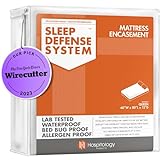
Sizing is by mattress depth as much as by width and length. A Queen encasement is cut for 60 x 80 inches and then sold in depth ranges, typically 9 to 12 inches for standard mattresses and 13 to 18 inches for pillowtops and thick hybrids. The HOSPITOLOGY PRODUCTS Mattress Encasement at $44 is a Queen in the standard 12-inch depth with a waterproof, stretchable knit; the Utopia Bedding Waterproof Mattress Protector Queen at $28.99 is a six-sided zippered encasement that is also marketed as bed bug proof. Expect to spend $25 to $60 for a Queen and $35 to $80 for a King, with allergen-certified medical-grade versions running higher.
Weight is 1.5 to 3 pounds. Most are machine washable in warm water and tumble dry on low; the polyurethane layer in waterproof models should not see high heat.
Pros
- Seals the mattress completely. Mites and their allergens already in the mattress are trapped inside, and the surface you sleep on is a washable barrier.
- Works for both dust mites and bed bugs when the zipper is fine-toothed and covered, so one purchase covers two problems.
- Waterproof versions protect against sweat, spills, and accidents, which extends mattress life and keeps warranty stains at bay.
- Machine washable. The encasement itself can be washed every 1 to 3 months, something you cannot do to a mattress.
- Low cost relative to the benefit, at $25 to $60 for a Queen, and it lasts 3 to 5 years.
- Silent and thin. Modern knit-and-membrane fabrics do not crinkle the way old vinyl covers did.
Cons
- Installation takes two people and 10 to 15 minutes for a Queen or King; a 100-pound hybrid is awkward to stand on end.
- Waterproof membranes trap a little heat. Hot sleepers notice a slight warmth compared with a bare mattress or a breathable pad.
- A poorly sized encasement bunches under the fitted sheet. Buy the depth range that matches your mattress, not the widest range available.
- It does nothing for pillows, the duvet, or the box spring unless you encase those too, and mite allergen lives in all of them.
- The zipper is the weak point. Cheap zippers split or lose teeth after a few washes, which defeats the seal.
- It will not fix an allergy on its own. Without weekly hot washing of sheets and pillow encasements, the benefit is small.
Who Should Buy It
Anyone with a confirmed dust mite allergy from a skin or blood test, anyone with asthma that flares at night, and parents of kids who wake up stuffy but clear within an hour of getting up. It also makes sense for people in humid climates, where mite populations are highest, and for anyone buying a new mattress who wants to keep it allergen-free from day one. Renters moving into furnished housing or using a secondhand mattress should treat an encasement as mandatory for both mites and bed bugs.
Who Should Skip It
Skip it if no one in the bed has symptoms and the mattress is under a few years old; a $15 to $30 fitted protector is enough for spills. Skip it if you already sleep on a latex mattress, which is naturally resistant to mites, and have no allergy symptoms. And skip the waterproof version if you sleep very hot and have no need for spill protection; a non-waterproof woven encasement breathes better and still blocks mites.
Cheaper Alternatives
| Option | Cost | Trade-off |
|---|---|---|
| Fitted five-sided mattress protector | $15 to $30 | Blocks spills and surface allergens but leaves the underside open; mites inside the mattress stay active |
| Pillow encasements only | $10 to $20 for two | Covers the item closest to your face; does nothing for the mattress |
| Weekly hot wash of all bedding at 130 F or higher | $0 beyond utilities | Kills mites on sheets but not inside the mattress |
| Vacuuming the mattress with a HEPA vacuum | $0 if you own one | Removes some surface allergen; mites deep in the foam remain |
| Bedroom dehumidifier kept under 50 percent humidity | $40 to $200 | Slows mite reproduction over months; no immediate barrier |
| Replacing the mattress | $300 to $1,500 | Removes existing mites but the new mattress colonizes within a year without an encasement |
FAQ
How often should I wash a mattress encasement?
Every 1 to 3 months in warm or hot water, more often if it is waterproof and has caught a spill. Between washes, wash sheets weekly. The encasement stays on the mattress; only the sheets come off each week.
Is a mattress encasement the same as a mattress protector?
No. A protector is a fitted sheet with a waterproof top that covers five sides. An encasement is a zippered bag that covers all six. Only the encasement seals the mattress against mites and bed bugs.
Do I need to encase the box spring too?
For dust mites, the mattress and pillows matter most because they are closest to your face. For bed bugs, yes, encase the box spring as well, since it is a common hiding place. A box spring encasement costs $20 to $40.
Will an encasement make my mattress hot?
A waterproof encasement adds slight warmth because the membrane blocks airflow. Choose a knit fabric with a breathable membrane or a non-waterproof woven encasement if heat is a concern. Most people heading into 2026 with a modern knit encasement do not notice a difference under a cotton fitted sheet.